Documentation Required For Colorado Clean Energy Rebates
Knowing the documentation required for Colorado clean energy rebates accelerates approvals. Riley Riley Construction prepares checklists and verifies paperwork for each program. Call 17209279730 to have your documents reviewed before submission. This reduces delays and increases approval rates.
Applying for clean energy rebates in Colorado can deliver meaningful savings, but the difference between a smooth approval and a lengthy delay often comes down to paperwork. At the heart of any successful application is a clear understanding of the documentation required for Colorado clean energy rebates. Whether you are installing solar panels, purchasing an electric vehicle, upgrading to a high-efficiency heat pump, or completing home weatherization, program administrators expect consistent evidence of eligibility, system specifications, and installation details.
Riley Riley Construction works with applicants to assemble complete, accurate packets tailored to the requirements of each program. We focus on preventing avoidable rejections by verifying that invoices, equipment model numbers, contractor credentials, and interconnection documents meet reviewer expectations. If you prefer a fast, informed review, call 17209279730 and allow us to check your documents before you submit them to the rebate administrator.
Why documentation matters: faster approvals and fewer surprises
Rebate programs are designed to distribute limited funds to projects that meet stated technical and administrative criteria. Documentation is how applicants demonstrate compliance. Missing or inconsistent documents force reviewers to place applications on hold while they request additional information; this commonly causes delays of weeks or months. Conversely, a complete, well-organized submission typically moves through the process much more quickly and is less likely to face scrutiny or conditional approvals.
Beyond speed, proper documentation reduces financial risk. Accurate invoices and signed contractor agreements protect homeowners from billing discrepancies and help ensure that incentive amounts are calculated correctly. For organizations and contractors, submitting compliant documentation can improve program relationships and reduce back-and-forth communication, which in turn increases the chance of secure and timely rebate payments.
Common documentation required for Colorado clean energy rebates
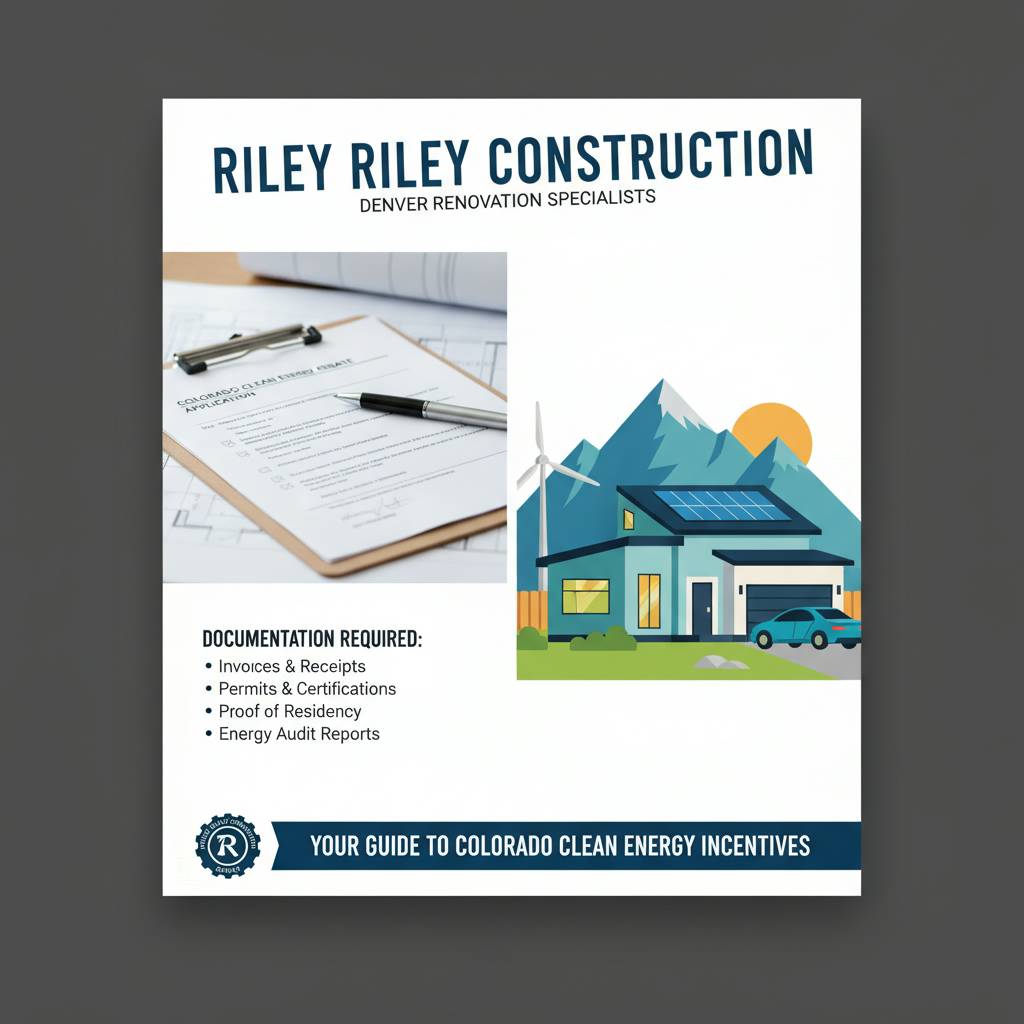 While requirements vary by program and utility territory, many rebate and incentive programs request a core set of documents. Preparing these standard items in advance will save time and make the submission process less stressful. Typical materials include proof of property ownership or lease, project invoices, equipment specifications, photos of installed equipment, and contractor licenses. Gathering these up front makes it easier to respond to specific requests from program administrators.
Below is a practical checklist you can use as a starting point. Treat it as a baseline - some programs will add or remove items depending on whether the project is residential or commercial, the program year, or special funding constraints.
- Proof of address or property ownership (utility bill, deed, or lease)
- Completed rebate application form (signed where required)
- Manufacturer specification sheets with model numbers and efficiency ratings
- Detailed invoices showing itemized equipment, labor, and total cost
- Contractor license or certification and proof of insurance
- Photographs of existing conditions and final installation, including serial numbers when applicable
- Interconnection agreement or utility approval (for distributed generation like solar)
- Proof of permit finalization or inspection reports, if required
| Document Type | Why It's Needed | Tip |
|---|---|---|
| Invoice / Receipt | Shows actual costs and equipment purchased | Include itemized breakdowns and dates |
| Product Spec Sheet | Verifies model numbers and performance metrics | PDFs from the manufacturer are preferred |
| Contractor License | Confirms eligible installers and workmanship standards | Include license number and state or local issuing authority |
Program-specific variations and examples
Different rebate offerings within Colorado can require tailored documentation. For example, utility-specific solar rebates typically demand a signed interconnection application and an equipment list that includes inverter and panel model numbers, while an EV charger rebate might require proof of charger make and model plus an invoice showing installation labor. Understanding these nuances is essential to avoid resubmission requests.
Residential solar and battery storage
For rooftop solar and battery projects, common submission items include the project proposal or one-line diagram, the installer's permit and final inspection document, equipment spec sheets, and utility interconnection confirmation. Many programs also ask for the production estimate or a Solar Renewable Energy Certificate (SREC) registration proof. If a battery is included, manufacturers' cycle-life and capacity specifications may be required to determine incentive tiers.
Electric vehicle chargers (Level 2 and public DC fast)
EV charger rebate applications often require a copy of the purchase invoice, the charger's technical specification sheet showing power output, and evidence that installation was completed by a qualified electrician. For workplace or public chargers, some programs request a hosting agreement or site map, and others ask for load-management details to qualify for higher incentive levels. Clear photos of the installed charger and serial number help prevent verification delays.
Heat pumps, weatherization, and building efficiency measures
Efficiency upgrades like heat pumps or insulation frequently require contractor scopes, load calculations, ACCA or Manual J sizing documentation, and final inspection or permitting records. For whole-home weatherization projects, auditors may require pre- and post-retrofit blower door or thermographic reports to document energy savings claims. Make sure testing and commissioning documentation is attached when the program awards incentives based on measured performance.
How Riley Riley Construction prepares checklists and verifies paperwork
Riley Riley Construction approaches every submission with a program-specific checklist that aligns with the most current rebate rules. We begin by identifying the exact rebate or incentive and the administering utility or agency, then map required documents to each program criterion. Our checklists reduce the cognitive burden for applicants by turning ambiguous requirements into a clear, actionable list of items to collect and submit.
Verification is more than a cursory review. Our team cross-checks model numbers against manufacturer databases, confirms that invoices show eligible equipment and eligible costs, and ensures contractor credentials are valid for the project location. Where necessary, we flag discrepancies and provide guidance on how to correct them - for example, requesting an updated invoice from a contractor or obtaining a permit finalization from the local building department.
Working with Riley Riley Construction can also save applicants money by helping them identify which program offers the best net incentive and pointing out common documentation pitfalls that might disqualify certain costs. This advisory step is especially useful for multi-measure projects where incentives may come from different sources with overlapping but distinct documentation expectations.
Common mistakes that delay approvals and how to avoid them
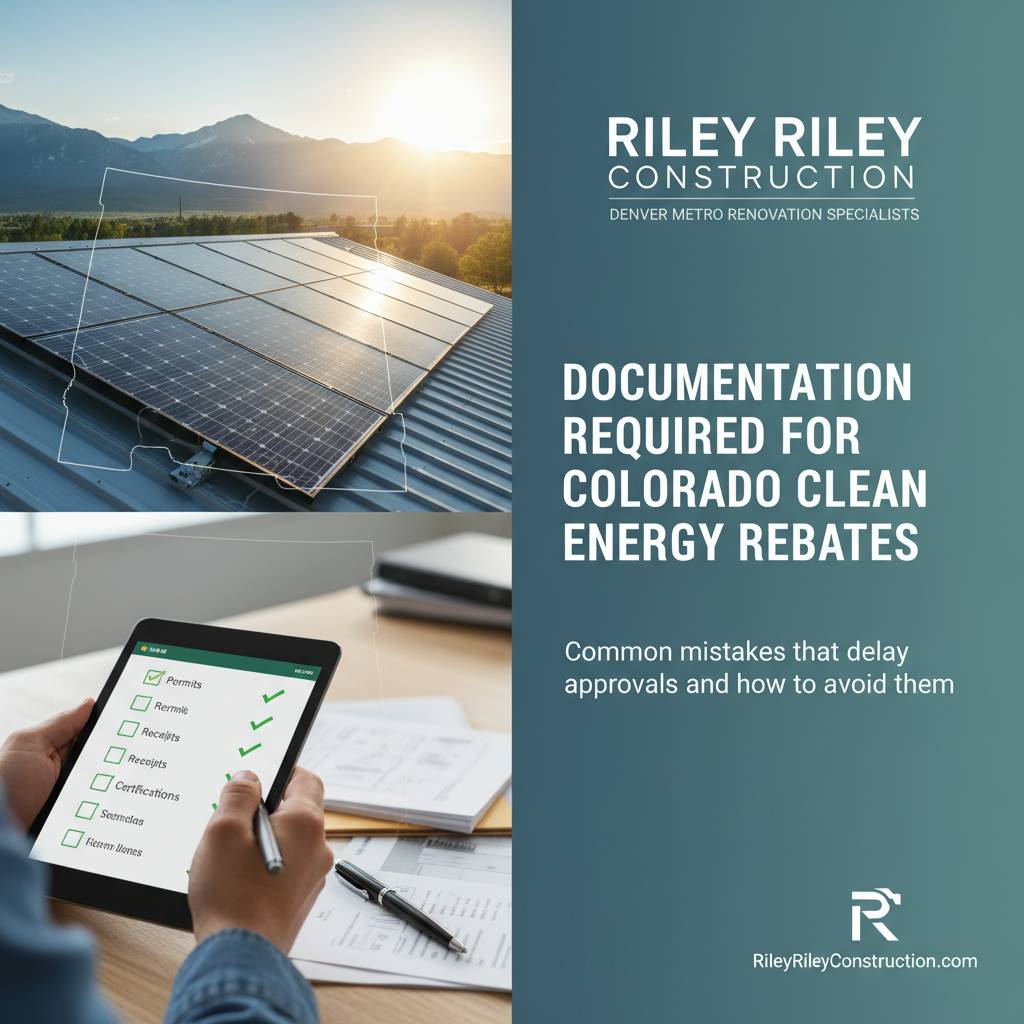 Understanding frequent mistakes can help applicants sidestep delays. One pervasive issue is submitting invoices that lack specificity: a single line item like "equipment and labor" rarely satisfies reviewers. Instead, invoices should list individual equipment model numbers, unit counts, per-unit costs, and any applied discounts or trade-in amounts. This level of detail helps administrators confirm the equipment meets program eligibility criteria.
Another common problem is mismatched project addresses or owner names across documents. Utility accounts, property deeds, and rebate applications should all reflect the same customer information. If you are an owner working on behalf of a landlord or a property management company, include signed authorization documentation that clarifies your relationship and permission to apply for incentives.
Finally, failing to include final inspection or permit completion documentation is a leading reason rebates are held. Program administrators often require proof that work was performed to code. Schedule and collect inspection reports promptly and add them to the application package. If an inspection is not required in your jurisdiction, obtain a signed contractor statement certifying completion and compliance.
Practical checklist: what to prepare before you apply
To streamline your rebate application, assemble a single folder that contains master copies of all likely documents. Doing this once saves time later when programs ask for supplemental materials. Below is a practical order for organizing your packet that reviewers will appreciate.
- Completed application form(s) with signatures
- Property ownership or tenant authorization
- Itemized invoice(s) and proof of payment
- Manufacturer spec sheets and warranty information
- Contractor credentials, permits, and inspection reports
- Photos of installation, including serial numbers and site context
- Any utility interconnection agreements or production estimates
Label digital files clearly (e.g., "InvoiceSolarCompanyName2026-04-07.pdf") and use common formats such as PDF or JPG. When programs request uploaded documents, ensure file sizes meet the portal's limits and that images are legible. If you rely on scans, verify text clarity and that no pages are inadvertently omitted.
Frequently asked questions about documentation required for Colorado clean energy rebates
We routinely hear similar questions from homeowners and contractors. Below are concise answers that address common concerns and help applicants plan ahead.
- Q: What if I don't have a contractor permit final yet?
A: Submit everything you have and clearly note that the permit final is pending. Some programs allow conditional approval, but final payment may be held until the permit final is supplied.
- Q: Can I submit electronic photos instead of hard copies?
A: Yes; most Colorado rebate portals accept electronic uploads. Ensure photos are high-resolution and clearly show model and serial numbers if requested.
- Q: Are invoices from friends or family accepted?
A: Programs require that work be performed by licensed or certified installers where applicable. Self-installation may be allowed for limited measures but often reduces rebate amounts.
- Q: How long should I expect processing to take?
A: Processing times vary widely - from a few weeks to several months - depending on program funding cycles and document completeness. A complete submission generally receives faster processing.
Next steps: preparing your submission and getting help
Begin by identifying the specific rebate program and reading its most recent application materials. Then, compile your documentation according to the program checklist. If you have any doubt about eligibility or which documents qualify, get a professional review. A second set of eyes often catches missing items and avoids the common back-and-forth that slows approvals.
Riley Riley Construction provides pragmatic document reviews, prepares program-specific checklists, and verifies that submissions match program rules. We can also advise on sequencing permit activity and scheduling inspections to align with rebate deadlines. In many cases our review prevents common errors that cause denials or lengthy holds on payments.
Call 17209279730 to schedule a document review and reduce the risk of delays.
Closing thoughts and contact information
Completing the documentation required for Colorado clean energy rebates can be straightforward when you understand what reviewers expect. Careful preparation, clear invoices, verified contractor qualifications, and timely inspection documentation are the foundations of a fast, successful application. Small investments of time in organizing and verifying paperwork have outsized benefits in approval speed and certainty.
If you want help preparing your materials or would like a professional checklist tailored to your project, contact Riley Riley Construction. Our team will review your application documents, point out any gaps, and recommend corrections so your submission moves forward without unnecessary delay. Reach out to Riley Riley Construction by phone at 17209279730 to get started.